canton midwife

brooke's ob patient story
OB Patient Stories

Quick and Unexpected Labor and Delivery

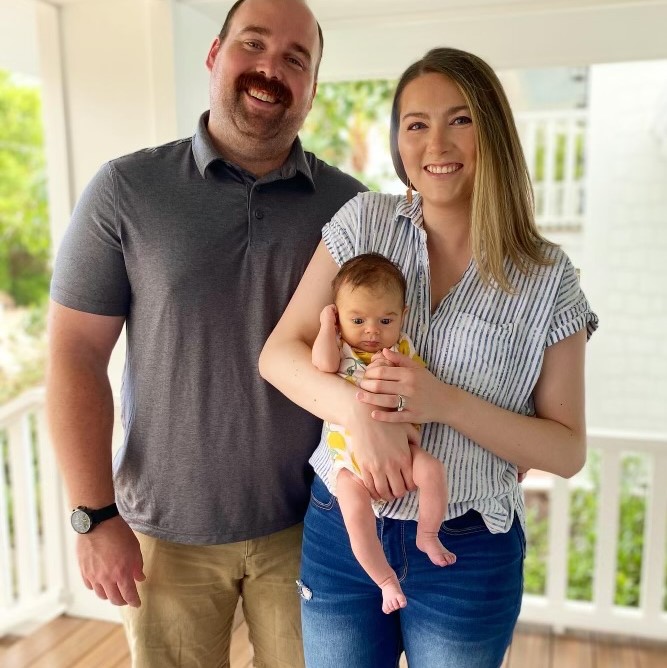
Brooke’s journey to motherhood seemed to happen quickly — from having baby fever to rushing to the hospital to giving birth! As a first-time mom, Brooke wasn’t exactly sure what to expect when she and her husband began trying to have a baby. Figuring it would take some time and special planning to get pregnant, she downloaded an app on her phone to track her cycle and bought a pack of pregnancy tests. However, very shortly after, her baby fever turned into a reality! One day, Brooke’s cycle tracking app notified her that it might be time to take a pregnancy test. She took the test and to her surprise, two pink lines appeared! “I took the first one and thought, ‘this can’t be right!’, so naturally I took two more. Sure enough, she was pregnant! I went from feeling really excited to really overwhelmed within the span of a few seconds. It was good excitement, I just needed my husband’s reassurance.” – Brooke recalling the moment of surprise Brooke felt great at the beginning of her pregnancy, with her only early symptom being morning nausea, which was relieved by over-the-counter remedies recommended by the physicians of Cherokee Women’s Health. Her pregnancy was relatively uncomplicated until halfway through her second trimester, when her lower legs and feet started to swell. “The swelling never went away. I’d wear compression socks all day long, every day, and I still swelled. It wasn’t a medical concern, just very uncomfortable! The care I received from everyone at Cherokee Women’s Health was great, especially the sonographer, Rachel. Every ultrasound was so fun and exciting with her.” Braxton Hicks or the Real Thing? As a nurse at Northside Hospital Cherokee, Brooke was still active and walking a lot before she went into labor. She felt cramps the day before delivery, but they weren’t consistent and were at least ten minutes apart. She figured they were Braxton Hicks contractions. “I wasn’t even willing to call them contractions because they weren’t nearly as bad as I’d expected. I even met my husband at Olive Garden for dinner that night!” – Brooke recalls of her contractions That same night, at 38 weeks pregnant, Brooke was up every other hour with slight pains. Since she had been experiencing similar feelings the prior two weeks, she wasn’t alarmed. “I wasn’t waking up and thinking, ‘Oh, I’m having contractions’, I was just waking up and thinking, ‘I must have to pee because I’m nine months pregnant,’” Brooke said. It was around 5 a.m. when the pains became stronger and closer together, although they were still 10 minutes apart. She still wasn’t too concerned and knew she didn’t want to go to the hospital until she absolutely needed to. Then suddenly, her pain started to feel like contractions and went from 10 minutes apart to four minutes apart in the span of an hour. “It was around 7:30 a.m. when I woke my husband up. To this day, he still laughs when he recalls that I had no urgency in my voice. He told me I just woke him up and said, ‘Hey, you might want to throw some stuff in the bag for the hospital,’ giving him the impression we’d have the baby in the next 24 hours.” As Brooke’s contractions intensified, she leaned against the bathroom countertops for support. The day before, she explained the 4-1-1 rule to her husband Brice, which is that you should go to the hospital when contractions are regularly coming four minutes apart, each one lasts at least one minute, and they have been following this pattern for at least one hour. With this in mind, Brooke’s husband looked at the app she was using to time the contractions and noticed they were much closer together and lasting longer than she thought. It was time to go to the hospital! Time to go to the Hospital Around 8:30 a.m., Brooke and Brice threw everything they needed into the car and headed to Northside Hospital Cherokee. They arrived 15 minutes later and Brooke was already in so much pain, she was unable to walk so her husband brought her a wheelchair, and they rushed into registration. Brooke’s contractions were two to four minutes apart at that point. “I was gripping the arm of the wheelchair at registration and told her my contractions might actually be closer than two to four minutes. Then I told her I thought my water had just broken. She said since it was my first baby, my water most likely didn’t break yet and then asked me to stand up on the scale to check my weight. After I stood on the scale, I saw a puddle of water in the wheelchair and on the scale. They quickly moved me to a delivery room.” – Mom-to-be Brooke, moments before giving birth On the way to delivery, Brooke was asked if she wanted an epidural. She answered that she wasn’t sure just yet. When they arrived in the room, the option for an epidural was taken off the table because Brooke was already nine and a half centimeters dilated! Midwife Susan Fischels Delivers Baby Carolyn Certified Nurse Midwife, Susan Fischels of Cherokee Women’s, was there to deliver Brooke’s precious baby girl. Brooke felt like her body kept wanting to go her left side, which she didn’t anticipate. Susan assured Brooke that moving positions was okay and to do what her body felt like it needed to do. With no pain medication and with Susan’s support, Brooke welcomed her baby girl, Carolyn, into the world at 9:52 a.m., exactly 55 minutes after arriving at the hospital. Carolyn weighed 6 lbs. 6 oz., which was ironically Brooke’s birth weight as well. “Susan was so fantastic. Her voice just cut through the chaos in the room. When she gave me directions, I locked in on them and followed her direction. As a first-time mom so far into labor and not having anything for pain, I was
Susan Griggs, APRN, CNM
Midwife Education

Founding Midwife Susan Griggs APRN, CNM

Nurse Midwife Susan Griggs, a Pioneer in Midwifery for Cherokee County, Announces Retirement Certified Nurse Midwife Susan Griggs was the only midwife in the practice when she joined Cherokee Women’s Health, as well as the only midwife delivering at Northside Hospital Cherokee. A pioneer in midwifery for Cherokee County, local resident Susan Griggs has helped deliver more than 1,000 babies at Northside Hospital Cherokee. First Midwife to Deliver Babies in Cherokee County Susan was the first midwife to deliver babies in Cherokee County, a crucial service that has helped save the lives of many babies. Providing much-needed education on the importance of prenatal care and contraception – as well as the importance of midwives – Susan leaves quite a legacy. In May 2022, the certified nurse midwife of Cherokee Women’s Health and local resident of Woodstock, stepped down from her role and into a new one: retirement. “I would like to thank my patients for letting me take care of them. It has been a privilege to deliver over 1,000 babies at Northside Hospital Cherokee. I’ve enjoyed the opportunity to provide gynecologic services and family planning for so many women in the community.” – Certified Nurse Midwife Susan Griggs Susan Joined Cherokee Women’s Health in 2007 Griggs came to the Northside Hospital-affiliated women’s health care clinic in 2007 after spending many years at Northside Atlanta and other hospitals around Atlanta. “Dr. Litrel and I both trained at Emory at Grady Hospital. I knew he had trained with midwives, and he wanted an experienced midwife on his team. Not all doctors work with midwives or know what we’re about, so we established a good relationship from the beginning, and it was a good match. The nurses had also worked with midwives, so they were very welcoming.” Co-workers added that it was Susan’s vision and leadership, along with Dr. Litrel, that formally established the midwifery program at Cherokee Women’s and Northside Hospital Cherokee. “Susan and I supported each other, and we’ve worked together intimately for a long time. She has helped mentor other midwives and nurses and has helped us build a strong team of midwives to incorporate into our practice.” Dr. Michael Litrel Susan adds, “I was the first midwife to be established at Northside Cherokee and deliver babies. As such, there were a lot of educational needs. This was something new in Cherokee County, so I did a lot of teaching. I also learned a lot from my colleagues. At Cherokee Women’s, there was – and continues to be – a great appreciation for midwives. It was very collaborative, which is what we all strive for. We want to help each other and learn from one another, and I’ve seen that growth and change over the years. It’s very empowering.” When asked about the role of a midwife, Susan shares, “Midwives learn and teach the natural process of labor and delivery. Just being a presence with the mother throughout the natural labor process is important. Doctors are always right there for a higher risk situation or for an emergency. Working collaboratively ensures the best outcome for the patient and baby and an overall positive birth experience.” Susan was Instrumental in Expanding OB Services at Cherokee County Health Department Susan also leaves behind a legacy of a long-term involvement with the Cherokee County Health Department. When she joined Cherokee Women’s Health, the Cherokee County Health Department only served women with gynecological needs. Susan was involved with the program as it expanded to include obstetrical services, which would have long-lasting, positive effects across the state of Georgia. Cherokee Women’s Health was founded in 1993 by a prominent Atlanta OB/GYN, Dr. James Cross. He was the first OB/GYN in the county with the sole purpose of improving the infant mortality rate. Within two years, he had reduced the infant mortality and morbidity rate by almost half. Dr. Michael Litrel joined the practice a few years later and became increasingly aware that more work needed to be done to help the women in the area who were without health insurance. “We knew we had to act and make a change because as women would show up at the hospital, their babies were dying, because they had no prenatal care at all. It was such a sad situation. Something had to be done, shares Dr. Litrel.” Susan and the doctors at Cherokee Women’s got involved by seeing patients at the Health Department that otherwise received no health care, usually due to cost. “Eventually, Susan would be the one to go to the health department and we’d supervise,” Dr. Litrel said. “It was a very synergistic process. We trained Health Department staff so those that didn’t have health insurance could receive care.” Cherokee Women’s was – and is – the Only Group to Deliver the Health Department’s OB Patients at Northside Hospital Cherokee Women’s Health began delivering the Health Department’s OB patients at Northside Hospital. They were – and continue to be – the only group that cares for Health Department patients. To qualify, patients had to go to at least one pre-natal visit at the Health Department. They would then be enrolled in the state program so when they went to the hospital in labor, they would be delivered by one of Cherokee Women’s midwives or doctors. At one time, Cherokee County had a 2.0 perinatal mortality rate, among the lowest in the state. Dr. Litrel says, “The new program that we implemented with the Health Department helped bring those numbers up dramatically. “We’re so thankful for all the people who got involved to make such a positive change in the community. It’s awesome to be a part of it.” Cherokee County is one of the few counties in the state (out of 159) that offers free obstetrical care through the Health Department. In fact, the program was so successful that several other Georgia counties followed suit and began the same model at their Health Departments. Unfortunately, many counties in Georgia still don’t offer

© Copyright 2024 Cherokee Women’s Health Specialists
Scroll to Top